What “House” Means in Casino Talk in Vietnam
Learn what “house” means in casino talk in Vietnam, distinguish the venue, operator, and game advantage, and choose a clearer translation for each use.
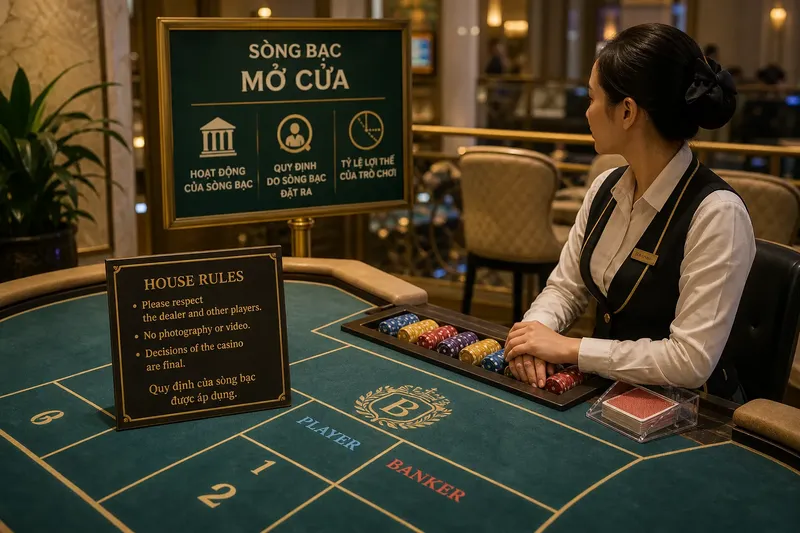
What does “house” mean on a casino sign in Vietnam: the venue, the business, or a game’s built-in advantage? The phrase “house meaning in casino talk in Vietnam” changes with the words around it, so translate the role rather than the word alone.
English casino terms can appear beside Vietnamese names, notices, and staff explanations. Start by asking what the sentence says the house does. A building can open; an operator can set a policy; a game can give the house an advantage.
Three possible meanings
In casino language, “house” commonly points to three different things:
- Venue: the casino as a physical place, as in “the house is open.”
- Operator: the organization running the venue, as in “the house sets the rules.”
- Game advantage: the structural edge associated with a game’s rules, as in “the house edge.”
These meanings can overlap in conversation, but they are not interchangeable in a translation. The verb and nearby nouns usually reveal which one fits.
Vietnamese translation choices
Translate the function of “house,” not its literal surface form. If it means the operator, choose Vietnamese wording that clearly identifies the casino or operating organization. If it means the building, use wording for the venue. The best choice depends on the full sentence and its intended reader.
For a working draft, mark each use as venue, operator, or game advantage. Then read the Vietnamese sentence without the English source. If the subject becomes unclear or sounds like a residential home, revise the wording or preserve the ambiguity until you can confirm the intended sense.
House rules and game terms
“House rules” refers to rules or policies set by a particular venue. At a table, it may describe how a game is offered or which actions are allowed. In another setting, it may describe conduct expected in the venue.
Do not treat “house rules” as a synonym for every rule of a game. A familiar game may have venue-specific details. In translation, separate the general rules of the game from the particular terms described in the notice.
“House edge” has a different meaning. It refers to an advantage built into a game’s structure over repeated play, not the result of one hand or spin and not an entrance fee. A player can win an individual round even when the game’s rules favor the house over time.
Context clues in a sentence
Check the verb, nearby nouns, and setting. “Sets,” “allows,” or “offers” often points to the operator. “Edge” points to the game’s structure. “Open,” “closed,” or “busy” can describe the venue.
Use this short editing checklist. For each observation, make the decision that follows rather than choosing a translation by instinct.
- Observation: “House” is paired with “edge.” If the sentence explains a game’s structure, then translate the game advantage; otherwise, inspect the surrounding words for another sense.
- Observation: “House” is the subject of “sets” or “allows.” If the sentence describes who establishes a policy, then translate the operator; otherwise, check whether the verb describes the venue itself.
- Observation: The sentence says the house is open or closed. If it describes access to a place, then translate the venue; otherwise, look for a stated organization or game rule.
- Observation: The text is a table notice. If it specifies actions during play, then treat it as a game or venue rule; otherwise, do not infer a rule from its location alone.
- Observation: The Vietnamese draft sounds like it refers to a home. If the English means a casino or operator, then replace the literal wording; otherwise, keep the place meaning if the sentence supports it.
- Observation: Two readings still fit after checking the sentence. If the distinction changes the meaning, then retain neutral wording or request a bilingual explanation; otherwise, choose the reading supported by the surrounding text.
How does the meaning shift?
Does “house” mean the dealer?
Usually not. A dealer may represent the casino at a table, while “the house” generally refers to the venue’s operating side rather than one employee.
Does “house edge” describe one result?
No. It describes an advantage built into a game’s structure, not the outcome of a particular hand or spin. A player can win an individual round.
Are house rules the same everywhere?
No. House rules refer to a particular venue’s policies, and details may differ between tables or locations. Translate the rule stated in the source instead of assuming every offering uses identical terms.
Can “house” mean the building?
Yes. In a sentence about a venue, “house” can mean the casino as a place. In “house edge,” it has a game-related meaning.
A worked translation choice
Say an invented translator has two English lines from a casino in Vietnam: “The house is open” and “House rules apply.” The translator marks the first line as venue because “open” describes access to a place. In the second, the surrounding sentence says players must follow a table’s instructions, so the translator marks it as operator policy, not the building and not the game advantage. The resulting Vietnamese draft uses a place-focused expression for the first line and a casino-policy expression for the second. If the source did not identify who set the table instruction, the translator would keep the wording neutral or ask for clarification rather than inventing an authority.
Choosing the final wording
When translating casino language in Vietnam, identify whether “house” means the venue, the operator, or a game advantage. Then check whether the chosen Vietnamese wording still assigns the action to the right subject. This distinction makes the house meaning in casino talk in Vietnam clearer without forcing one translation onto every phrase.
When the source leaves the subject genuinely uncertain, preserve that uncertainty where the target language allows it. A precise translation reflects what the sentence establishes, not what a reader might assume from the word “house” alone.