From Private Clubs to Public Entertainment in Vietnam’s Casino History
Vietnam casino history becomes easier to read through colonial hotels, legal change, and resort design, with practical ways to separate evidence from claims.
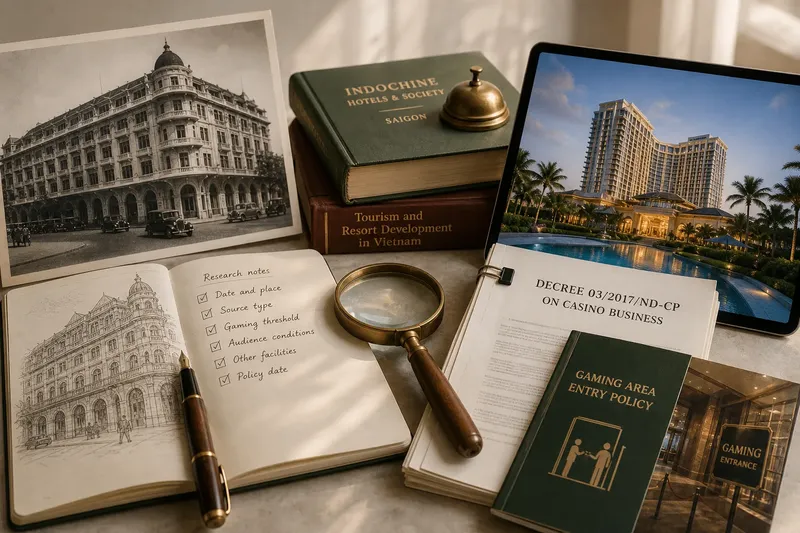
What does Vietnam casino history actually tell you about who could enter, and what a venue was meant to offer? Start with the distinction between a dated hotel account, a law, and the visible layout of a property: each can support a different kind of claim.
Colonial-era Saigon had casinos associated with hotels, while modern resort development places gaming within broader hospitality settings. The Grand Hôtel de Saïgon is often linked to early casino history, but claims about its opening date or gaming rooms should be checked against reliable historical records before being repeated as fact.
Colonial hotel leisure
Under French colonial rule, Saigon’s hotels formed part of a leisure economy shaped by unequal political and social conditions. Gaming connected to a hotel was not simply a public civic attraction. Its setting says something about how leisure was packaged, but it does not establish who was admitted or how guests experienced the room.
Descriptions of the Grand Hôtel de Saïgon, now known as the Hotel Majestic, often place it in this history. Treat specific dates and claims about its casino as matters to verify in archival records or credible institutional histories. A building’s architecture can show how arrival, dining, and other functions were arranged; it cannot independently prove the rules at a gaming threshold.
Keep the evidence types separate. A period photograph can document a facade or room arrangement. A hotel history can report an institution’s account of its past. Neither alone settles questions of access or everyday use.
Political and legal change
War and political change disrupted the continuity of commercial leisure institutions. After reunification, the state context for gambling differed from the colonial setting. Later economic reforms and tourism development created conditions for regulated casino businesses.
Decree 03/2017/ND-CP is a relevant legal text for understanding casino business regulation in Vietnam. Read the decree itself, or a current official government explanation, when making a claim about its provisions. Do not use a general historical account to answer a present-day question about eligibility or entry; check current official rules and the venue’s published policy.
A hotel lobby, restaurant, or pool may have different access conditions from a gaming area. The physical boundary can help explain how a venue organizes space, but legal requirements and current venue policy determine access.
Resort-era presentation
Modern resort properties place gaming alongside accommodation, dining, and other leisure facilities. The Grand Ho Tram in Ba Ria–Vung Tau is an example commonly associated with this development. Verify specific opening dates and facility details through reliable records before using them as firm historical facts.
The resort format changes how gaming is presented: it can appear as one part of a destination rather than as a stand-alone room in an urban hotel. That does not mean every guest can enter every area. Public-facing hospitality and controlled gaming access can coexist on the same property.
Say you are planning dinner at a resort with a companion who hopes to enter its gaming area. You check the venue’s current official entry information and find that dining is available to both of you, while gaming has separate eligibility conditions. You decide to book dinner together and have your companion proceed to the gaming entrance only if they meet those conditions. The observable result is a shared meal, with the gaming decision kept separate from access to the restaurant.
Reading Vietnam casino history?
What does a hotel date establish?
A verified opening date can place a hotel in a historical timeline. It does not, by itself, prove when a casino began operating there or who entered it.
What changed with resort development?
Resort properties present gaming alongside a broader hospitality offer. That changes the venue’s format, but it does not remove separate access rules for gaming areas.
Does a public lobby mean open gaming access?
No. A lobby or restaurant may welcome hotel guests while gaming areas have distinct eligibility requirements. Check current official rules and the venue’s entry policy before planning access.
What can architecture establish?
Entrances, signs, reception points, and room placement can document visible divisions within a property. They cannot independently establish who used a space or what visitors privately experienced.
Evidence checks
Use these checks when reading a history or assessing a venue. Each observation should lead to a limited, clear conclusion.
- Date and place: If a credible source names a venue and supports a date, use that date only for the claim it documents; if either is missing, describe the account as unverified and look for a dated archival or institutional record.
- Source type: If the source is a legal text or archival record, identify that basis; if it is promotional copy, describe it as the venue’s own presentation and seek independent corroboration before treating historical claims as established.
- Gaming threshold: If signs or staff visibly mark a separate gaming entrance, record that boundary; if no boundary is visible, do not infer unrestricted access and check the venue’s stated policy.
- Audience conditions: If an official policy clearly states entry requirements, use it to decide whether a visit is appropriate; if the policy is unclear, contact the venue or consult the relevant official authority before making plans.
- Other facilities: If the property’s official materials list dining, accommodation, or leisure alongside gaming, call it a mixed-use hospitality setting; if they do not, avoid claiming a broader leisure offer.
- Policy date: If access information is current and published by an official source, use it for planning; if it is undated or unofficial, verify it directly before relying on it.
Imagine you are writing a short caption about a hotel photograph. Your starting materials are an undated image of a facade, a hotel webpage describing its history, and a current official entry policy. First, record only the visible facade details from the image. Next, check whether the webpage supports the historical date you want to mention; if it does not cite a record, leave the date out or qualify it as the hotel’s account. Then use the current policy only for present-day access, not as evidence about past visitors. Your final caption can describe the visible building and attribute the hotel’s historical account, while making no unsupported claim about earlier gaming access.
Separate claims carefully
Vietnam casino history is not a smooth passage from private club to open public entertainment. Colonial hotel leisure, later political and legal change, and resort development belong to distinct settings. Their connection is the pairing of gaming with hospitality, shaped in each period by different power relations, rules, and ways of presenting a venue.
When you encounter a claim about Vietnam casino history, ask what kind of evidence supports it: a dated record for chronology, a legal text for regulation, or observable features for spatial layout. Keeping those answers distinct lets you describe a venue accurately without turning a hotel’s promotional story or an open lobby into proof of unrestricted access.