Roulette and Baccarat Table Rituals in Vietnam
Roulette and baccarat table rituals in Vietnam reveal how wheel, cards, dealer calls, and local room design shape casino entertainment for observers.
Where should you look first when comparing roulette and baccarat table rituals in Vietnam? Start with the room’s design, then follow the objects and calls that direct attention. A roulette wheel makes motion visible; baccarat centers the sequence on cards. The contrast can help you read a casino floor as entertainment rather than treat a result as a prediction.
Vietnam’s casino venues are not interchangeable. A resort casino may sit within a larger complex of hotels, dining, and performances, while access rules and available games vary by venue. Observe only where entry is permitted, follow posted rules, and ask staff before taking notes, photos, or approaching a table.
Rooms and rituals
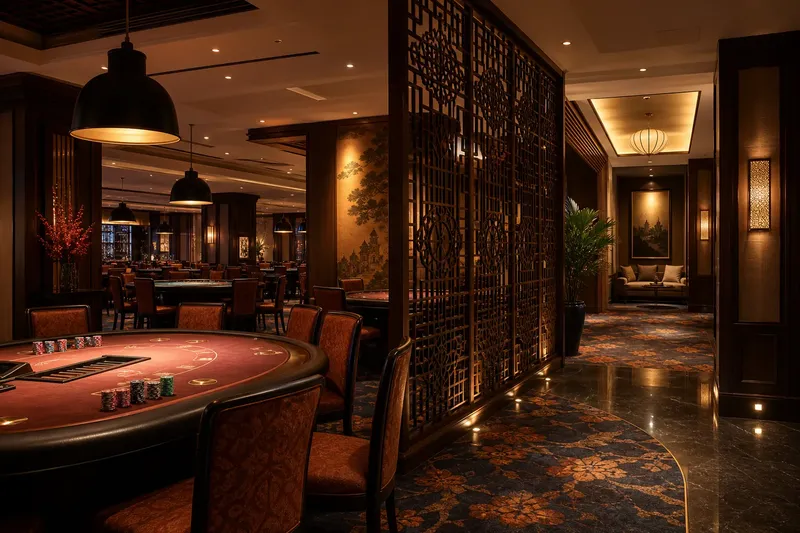
Before focusing on either game, notice how the venue separates activities. Signs, lighting, carpet patterns, table placement, and the distance between gaming areas and other amenities all shape how visitors move through a space. These details are part of the public setting, not evidence about the people who use it.
At a table, stay where you can see the dealer and game equipment without crowding players. If the view is blocked or the rules are unclear, step back or ask staff what is allowed. Keep your phone away unless photography is explicitly permitted.
Casino language may combine English game terms with local signage or staff instructions. Listen for the terms used at that specific table instead of assuming every venue follows the same wording. A small notebook is useful only if writing is allowed and does not distract anyone.
Roulette’s moving focus
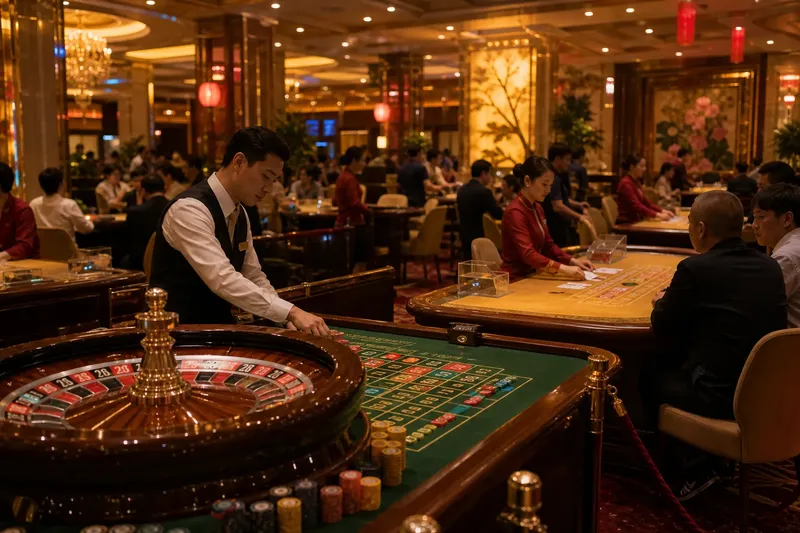
Roulette directs attention across the table. Players place chips on a numbered layout, the dealer closes betting, the ball travels around the wheel, and the table turns toward the result. The layout can look busy, but the wheel gives spectators one clear moving point to follow.
No more bets signals that the betting period has closed. A pocket is the numbered slot where the ball settles, and a spin is the round centered on the wheel. These words describe table actions; they do not imply anything about later results.
The rhythm alternates between an open period of activity and a short stretch when attention converges on the wheel. Players may point or lean toward the layout, while spectators track the ball. Once the result is called, the dealer resets the table for another round.
Baccarat’s card sequence
Baccarat keeps the main action close to the cards. Bets are placed, cards are dealt, the hand is checked, and the round is settled. The sequence is usually easier to follow if you can see the cards and hear the dealer’s cues.
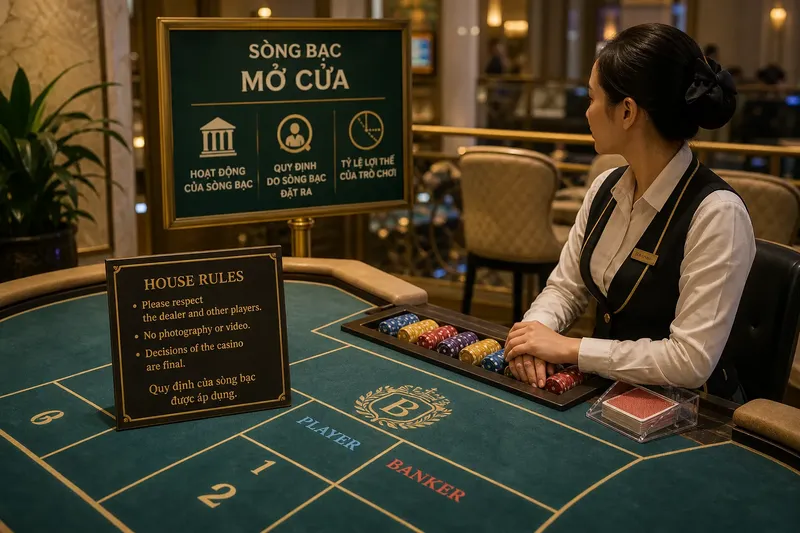
Player, Banker, and Tie are outcome labels. They do not necessarily describe the people seated at the table. A shoe holds cards for dealing, while a hand refers to the cards assigned to an outcome in that round.
Procedures vary by table. In some formats, the dealer handles the cards throughout; in others, players may have a visible part in dealing or turning them. Watch the dealer’s sequence and follow the posted rules rather than treating a gesture as universal.
Different kinds of attention
Both games move through action, a moment of resolution, and a reset. Their main difference is what holds the audience’s focus:
- Central object: Roulette draws attention to the wheel and layout; baccarat draws it to the cards.
- Visible motion: Roulette builds its public pause around the ball’s path; baccarat centers the reveal on dealing and checking cards.
- Table language: Roulette uses terms such as spin and pocket; baccarat uses Player, Banker, Tie, and shoe.
- Room sound: Roulette may gather attention around a closing call and wheel; baccarat cues attention through card actions and announcements.
Neither format is inherently more dramatic. Roulette makes anticipation visible through motion, while baccarat concentrates it in a compact sequence. In a resort setting, those rituals share space with other entertainment, but the table itself remains legible through its equipment, vocabulary, and repeated actions.
What should you notice?
Can you watch a table without playing?
That depends on the venue and its access rules. Check signs or ask staff before approaching, and watch only from an area where observation is permitted.
Which game is easier to follow from a distance?
Roulette’s wheel makes its central action conspicuous, though the layout can be visually dense. Baccarat is easier to follow when you have a clear view of the cards and can hear the dealer’s cues.
What does “no more bets” mean?
It marks the close of betting for that round. At roulette, it typically comes before the ball’s result, but the venue’s procedure and timing take precedence.
Are Player and Banker people at the table?
In baccarat, those words name possible outcomes for the hand. They do not necessarily identify the players or dealer.
A focused observation pass
Choose a permitted viewing spot and follow one cue at a time. Use these checks to decide what to observe next:
- Access: Check the signs and ask staff if needed; if observation is allowed, stay in the marked public area, and if not, choose another permitted space.
- View: Check whether you can see the dealer and equipment; if both are visible, follow the action, and if not, move back or stop observing.
- Sound: Check whether dealer calls are audible; if they are, note the words that mark transitions, and if not, track visible actions instead.
- Roulette sequence: Watch for the closing call, ball movement, result, and reset; if you can follow all four, compare the pauses, and if you lose the sequence, focus only on the wheel.
- Baccarat sequence: Look for dealing, checking, settlement, and reset; if the cards are visible, follow their order, and if they are not, listen for the dealer’s cues or choose another view.
- Note-taking: Check the venue’s rules before writing or using a phone; if notes are permitted, record neutral game terms, and if not, observe without recording.
- Privacy: Check that your attention stays on the game rather than individual players; if you can describe only public actions, continue, and if notes would identify someone, leave those details out.
Say you are in an invented situation at a Vietnamese resort casino, where staff confirm that viewing from a public walkway is allowed but photography is not. You first check that the roulette dealer and wheel are visible, then listen for “no more bets,” follow the ball to its pocket, and note the dealer’s reset without using your phone. Next, you check that the baccarat cards can be seen; because they are partly blocked, you shift to listening for the deal and settlement cues rather than guessing at the cards. The resulting comparison is concrete: roulette’s sequence is visible through wheel motion, while baccarat’s remains clearer through spoken cues from that position. You leave out details about players and stop if the walkway becomes crowded.
Reading Vietnam’s casino spaces
Casino culture in Vietnam is not captured by a single table or venue. A game’s language and architecture meet the larger setting: resort circulation, signs, shared entertainment areas, and local rules determine where visitors can go and what they can observe. Keep those boundaries in view, and distinguish what the room shows from assumptions about its audience.
For a useful comparison of roulette and baccarat table rituals in Vietnam, choose one visible cue and follow it from start to reset. The wheel’s path or the cards’ sequence gives you a specific account of how each table organizes attention, even when venue access or room layout limits what you can see.